Heat Pipes vs Vapor Chambers: Which Is Better for Your Design?
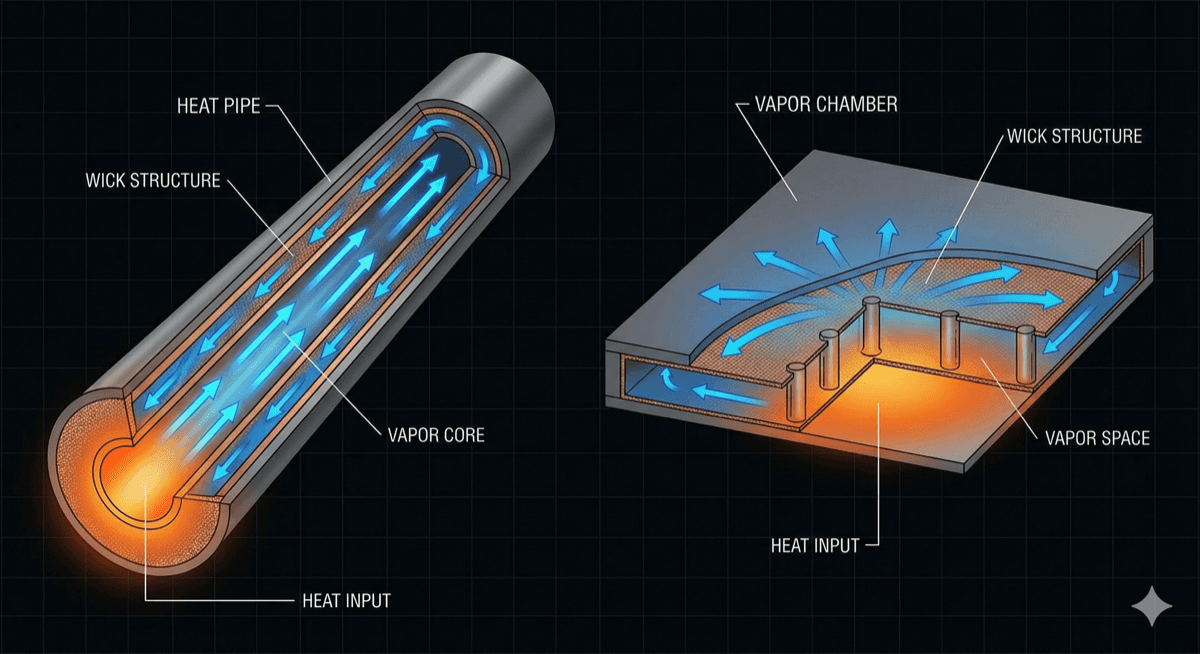
Heat pipes and vapor chambers are two-phase heat transfer devices that provide exceptional thermal conductivity for spreading heat from concentrated sources. Understanding their differences, advantages, and ideal applications helps engineers select the right technology for their thermal management challenges.
Operating Principles
Both heat pipes and vapor chambers use the same fundamental physics but in different geometries.
Two-Phase Heat Transfer:
- Heat input evaporates working fluid at hot end
- Vapor travels to cooler region (near-isothermal)
- Vapor condenses, releasing latent heat
- Liquid returns to evaporator via wick (capillary action)
Effective thermal conductivity: 5,000-200,000 W/mK Compare to: Copper at 390 W/mK
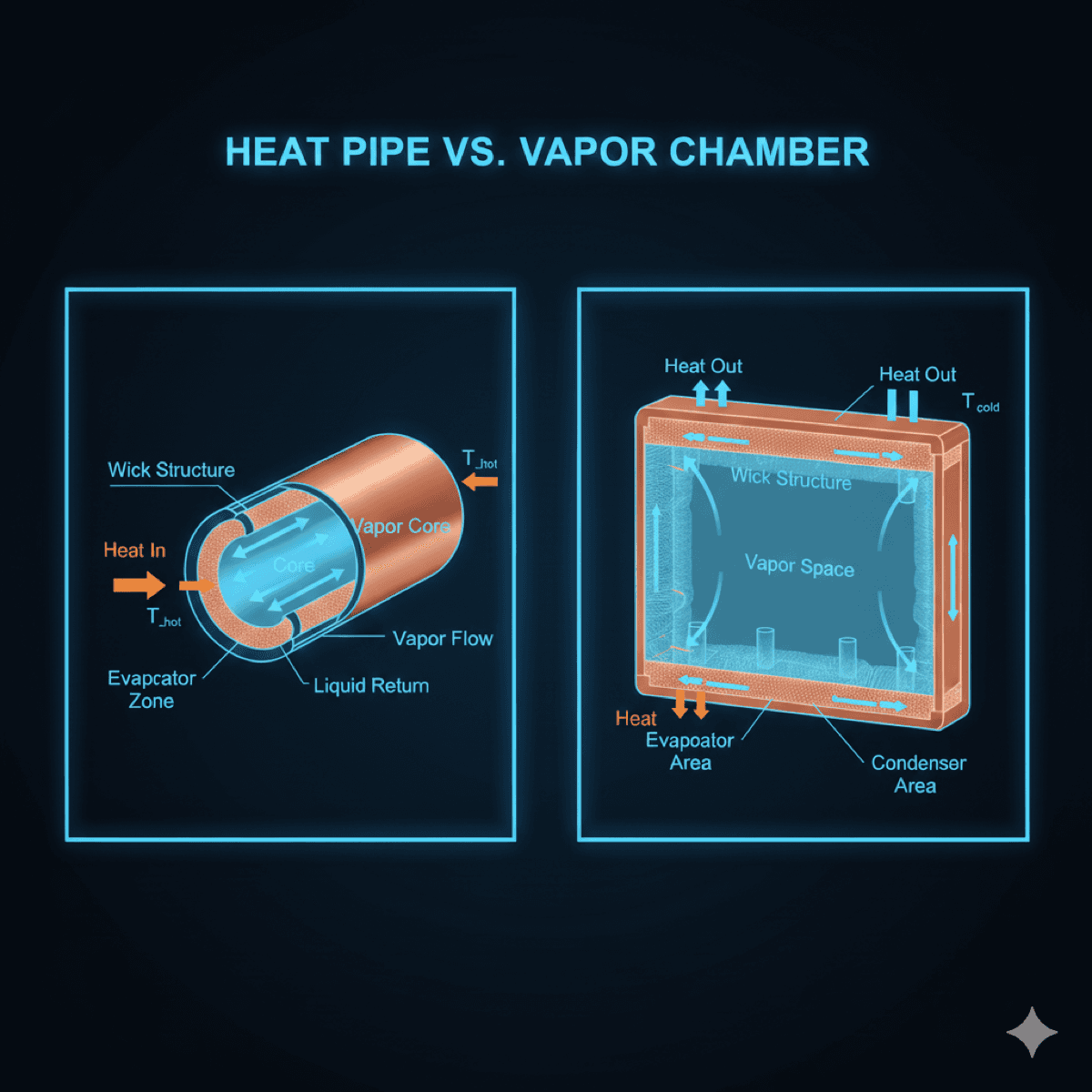
Heat Pipes:
Geometry: Cylindrical tubes, typically 3-12mm diameter Heat transport: One-dimensional (along length) Typical length: 50-300mm Best for: Moving heat from point A to point B
Working fluids:
- Water: 30-200°C (most common)
- Methanol: -40 to 100°C
- Ammonia: -60 to 80°C
- Acetone: -20 to 100°C
Vapor Chambers:
Geometry: Flat plates, 2-5mm thick Heat transport: Two-dimensional (spreads heat across plane) Typical size: 30×30mm to 200×200mm Best for: Spreading heat from small source to large area
Same working fluids as heat pipes, with water being most common for electronics cooling.
Key Differences:
| Aspect | Heat Pipe | Vapor Chamber | |--------|-----------|---------------| | Geometry | 1D tube | 2D plate | | Spreading | Poor | Excellent | | Transport distance | Long | Short to medium | | Cost | Lower | Higher | | Integration | Requires mounting | Direct attach possible |
Heat Pipe Types and Configurations
Heat pipes come in various configurations for different applications.
Standard Cylindrical Heat Pipes:
- Round cross-section
- Most economical
- Easy to bend for complex routing
- Typical Qmax: 10-100W per pipe
Flattened Heat Pipes:
- Cylindrical pipes pressed flat
- Better surface contact
- Reduced height (3-5mm possible)
- Some performance reduction from flattening
Sintered Wick Heat Pipes:
- Sintered metal powder wick
- Highest capillary pumping
- Works against gravity
- Best for demanding applications
Grooved Wick Heat Pipes:
- Axial grooves machined in wall
- Lower cost than sintered
- Gravity-dependent orientation
- Good for horizontal applications
Mesh Wick Heat Pipes:
- Wire mesh wick
- Moderate performance
- Good balance of cost/capability
Configuration Options:
Embedded in heatsink:
- Pipes pressed into grooves
- Spreads heat across base
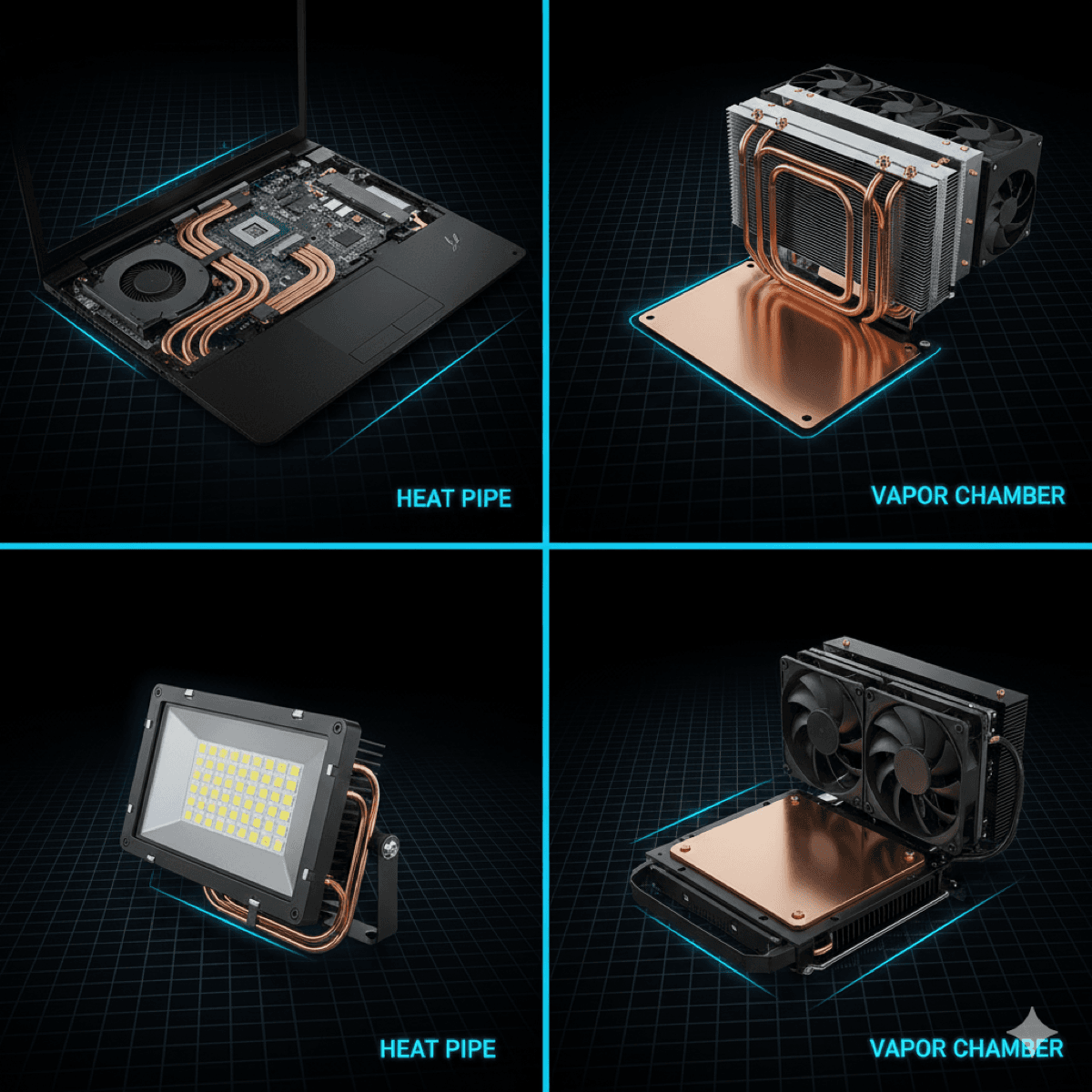
- Common in CPU coolers
Remote condenser:
- Long pipes to external heatsink
- Moves heat outside enclosure
- Good for sealed systems
Loop heat pipes:
- Separate liquid and vapor paths
- Works over long distances
- Complex, specialized applications
Vapor Chamber Design Considerations
Vapor chambers excel at heat spreading but require careful design.
When Vapor Chambers Excel:
Small heat source, large heatsink:
- 10×10mm chip to 100×100mm heatsink
- Spreading resistance dominates
High heat flux:
-
30 W/cm² at heat source
- Solid materials create hotspots
Thin profile required:
- 3-5mm total height
- Tablets, laptops, LED lighting
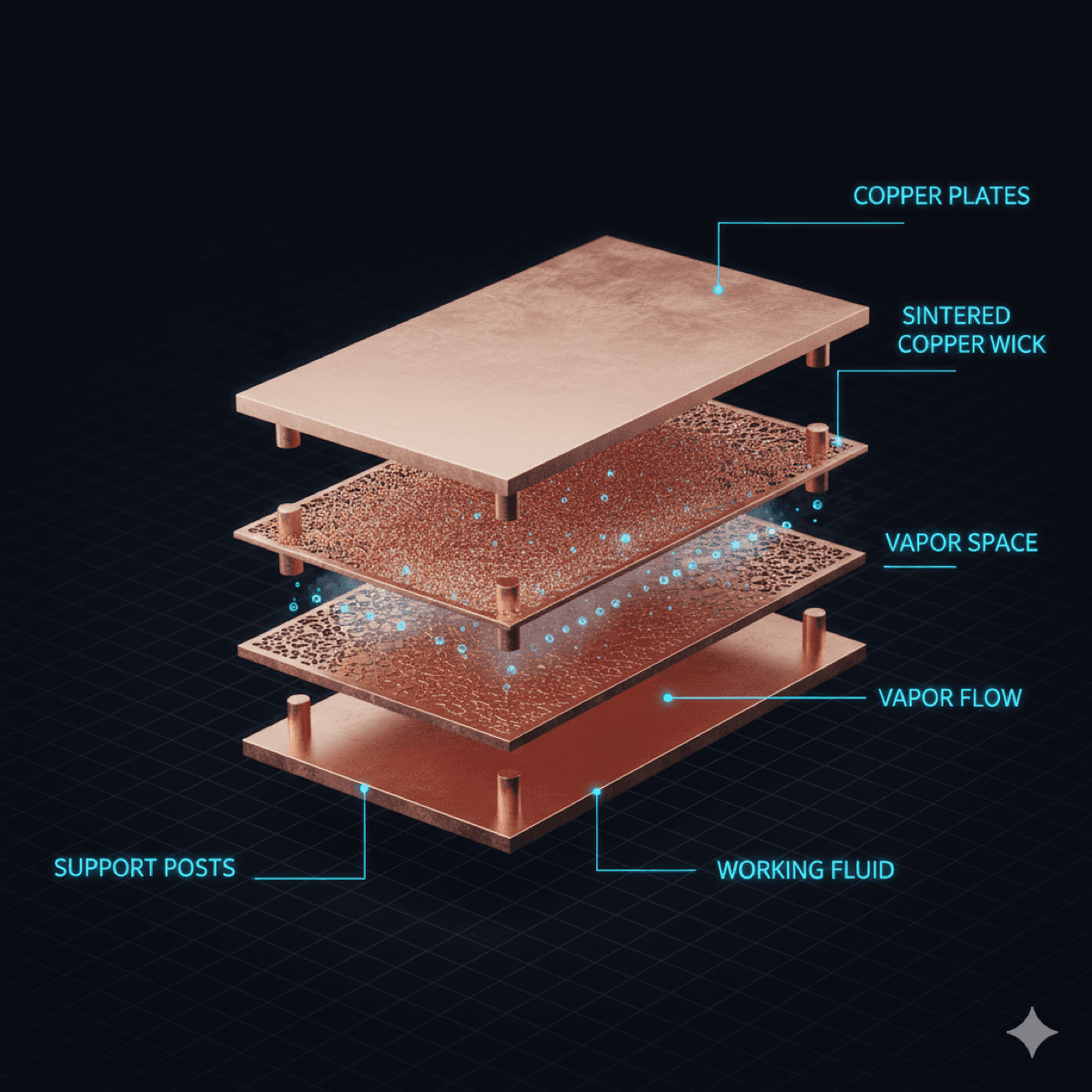
Vapor Chamber Construction:
Top and bottom plates:
- Copper most common
- 0.3-1mm thick each
Wick structure:
- Sintered copper powder (best)
- Copper mesh
- Grooved surfaces
Internal supports:
- Posts or columns
- Prevent collapse under vacuum
- Affect vapor flow
Design Parameters:
Size:
- Match to heat sink footprint
- Oversizing wastes cost
- Undersizing limits spreading
Thickness:
- Thinner = lighter, less vapor space
- Thicker = better performance, heavier
- Typical: 2.5-4mm
Evaporator location:
- Center is most forgiving
- Edge locations more challenging
- Multiple sources require careful wick design
Performance Limits:
Capillary limit:
- Wick can't return liquid fast enough
- Related to wick properties and distance
Boiling limit:
- Bubble formation blocks vapor
- Related to wick thickness and heat flux
Entrainment limit:
- Vapor drags liquid wrong direction
- More concern for heat pipes than VCs
Sonic limit:
- Vapor reaches sonic velocity
- Rarely a concern for electronics cooling
Performance Comparison
Understanding performance trade-offs helps with technology selection.
Effective Thermal Conductivity:
Heat pipes:
- 5,000-50,000 W/mK (along length)
- Negligible perpendicular to axis
Vapor chambers:
- 1,000-10,000 W/mK (in-plane)
- Limited through-thickness spreading
Solid copper:
- 390 W/mK (all directions)
Heat Transport Capacity:
Heat pipes (6mm diameter):
- Horizontal: 30-80W typical
- Against gravity: Reduced by ~20% per 25mm elevation
Vapor chambers (50×50mm):
- 50-200W typical capacity
- Less orientation sensitive
Spreading Resistance:
For 10×10mm source to 50×50mm sink:
Vapor chamber: 0.1-0.3°C/W Copper plate (3mm): 0.5-1.0°C/W Aluminum plate (3mm): 0.8-1.5°C/W
Vapor chamber provides 3-5× better spreading.
Temperature Uniformity:
Vapor chambers inherently create uniform temperature across their surface:
- ΔT across vapor chamber: 1-5°C typical
- ΔT across solid plate: 5-20°C typical
Transient Response:
Both technologies have thermal mass from:
- Metal shell and wick
- Working fluid
Response time similar to solid metal of same mass. Working fluid phase change adds thermal capacitance.
Application Guidelines
Selecting between heat pipes and vapor chambers depends on the specific application requirements.
Use Heat Pipes When:
Point-to-point heat transfer:
- Moving heat from source to remote heatsink
- CPU to chassis, LED to heatsink
Space is constrained:
- Pipes can route around obstacles
- Bend radii of 10-20mm typical
Cost is primary driver:
- Heat pipes significantly cheaper
- Especially for simple geometries
Existing heatsink design:
- Add pipes to improve base spreading
- Retrofit without major redesign
Use Vapor Chambers When:
Maximum spreading needed:
- Small source (<20mm²)
- Large heatsink (>100mm²)
Ultra-thin profile:
- 3-5mm total solution height
- Mobile devices, displays
Multiple heat sources:
- Several components on single plate
- Shared cooling surface
Uniform temperature required:
- Even temperature across surface
- Sensitive to temperature gradients
Hybrid Approaches:
Vapor chamber + heat pipes:
- VC spreads under source
- Pipes transport to remote condenser
- Best of both technologies
Embedded heat pipes in VC:
- Transport capacity of pipes
- Spreading of VC
- Premium applications
Quick Selection Guide:
| Requirement | Solution | |------------|----------| | Transport >100mm | Heat pipes | | Spread from <10mm source | Vapor chamber | | Height <5mm | Vapor chamber | | Cost critical | Heat pipes | | Multiple sources | Vapor chamber | | Route around obstacles | Heat pipes |
Integration and Manufacturing
Successful implementation requires understanding manufacturing and integration considerations.
Heat Pipe Integration:
Mounting methods:
- Epoxy bonding (thermal, structural)
- Mechanical clamping (removable)
- Solder/brazing (best thermal, permanent)
- Press-fit into grooves
Interface considerations:
- Flatten contact area for pipes
- Use TIM to fill gaps
- Ensure consistent contact pressure
Bending:
- Minimum bend radius: 3× diameter
- Flatten at bend reduces capacity
- Multiple bends reduce performance
Vapor Chamber Integration:
Mounting:
- Direct component attach (solder, TIM)
- Bolt-through mounting holes
- Edge clamping
Surface finish:
- Flatness: <0.1mm typical requirement
- Roughness: Ra 1.6μm for good TIM performance
Thermal interface:
- Attach source directly to VC surface
- Heatsink attaches to opposite side
- TIM on both interfaces
Manufacturing Considerations:
Heat pipe MOQ: 100-1000 pieces typical Vapor chamber MOQ: 500-5000 pieces typical
Lead times:
- Stock heat pipes: 2-4 weeks
- Custom heat pipes: 6-10 weeks
- Vapor chambers: 8-14 weeks
Tooling costs:
- Heat pipes: Low ($0-5k for bends/flattening)
- Vapor chambers: Medium ($5k-20k for stamping)
Quality Assurance:
Testing:
- Thermal performance verification
- Leak testing (He leak check)
- Burst pressure test
- Life testing (thermal cycling)
Incoming inspection:
- Visual for damage
- Dimensional verification
- Sample thermal testing
Common Failure Modes:
- Wick degradation (contamination)
- Non-condensable gas generation
- Physical damage to shell
- Freeze/thaw damage