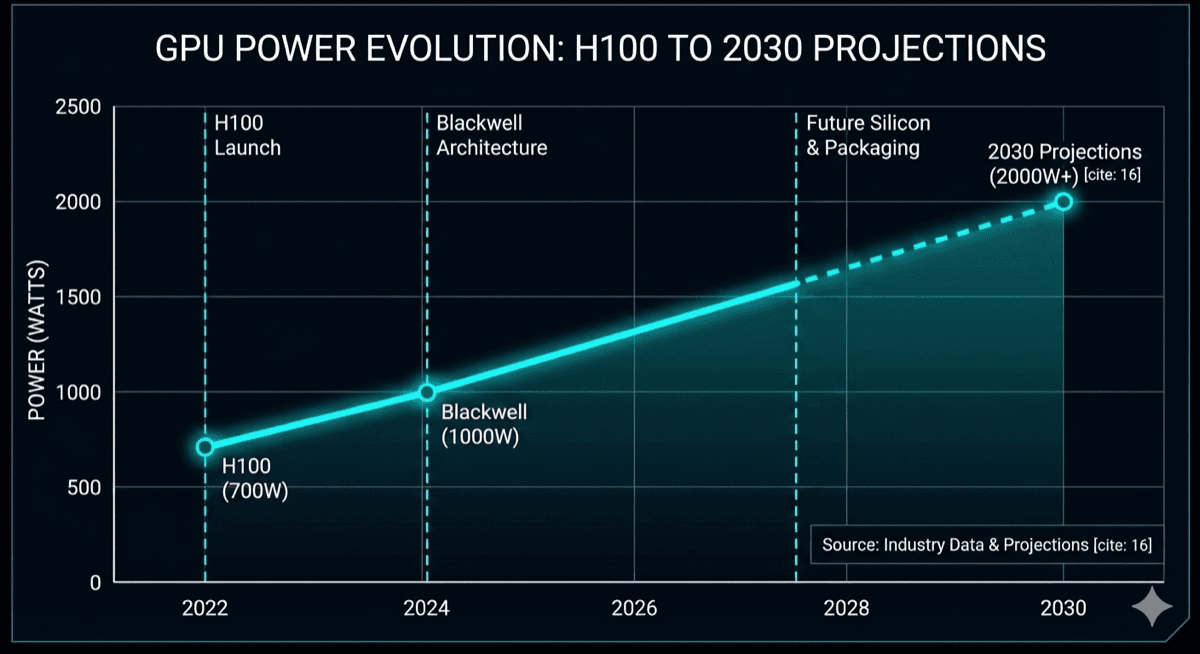
1000W Per Chip: Thermal Challenges of Next-Gen AI Accelerators
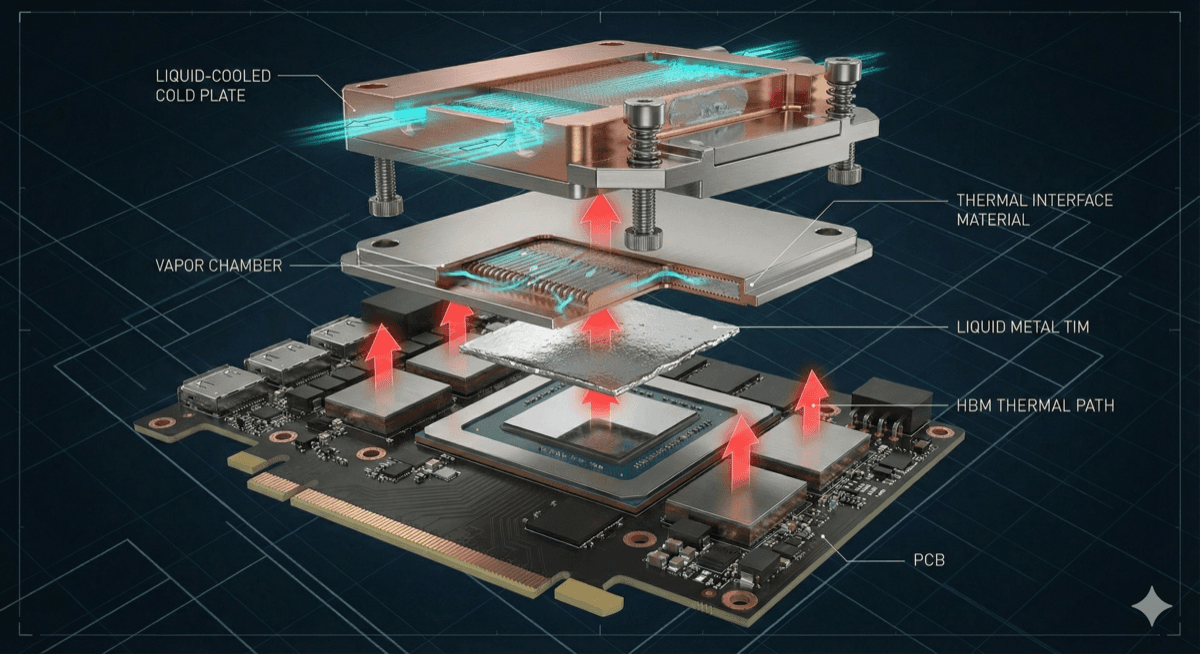
NVIDIA's Blackwell architecture will push GPU power consumption past 1000W. AMD's MI300X already dissipates 750W. These power levels, concentrated in packages smaller than a smartphone, create thermal challenges that would have seemed impossible a decade ago. This article examines the physics of cooling chips at kilowatt-scale power densities and the engineering approaches enabling next-generation AI accelerators.
The Physics of High Heat Flux Cooling
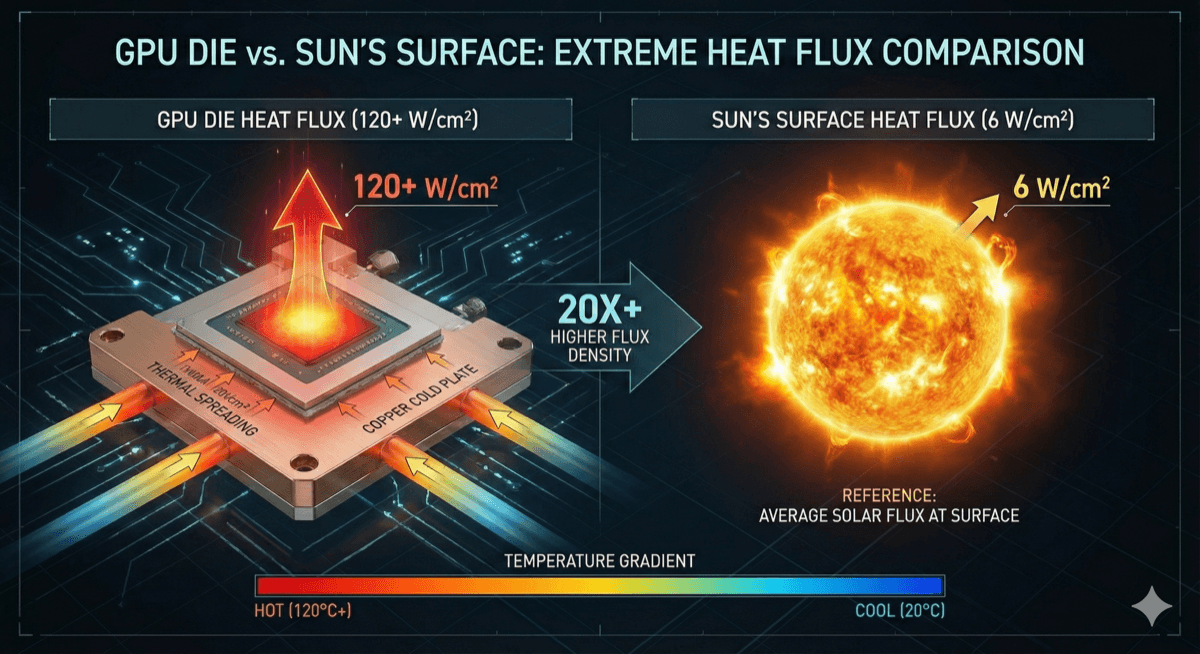
At 1000W in a package with ~800mm² die area, heat flux exceeds 120 W/cm². For comparison, the sun's surface produces about 6 W/cm². Managing these extreme heat fluxes requires understanding fundamental thermal physics:
Conduction Limits: Heat must first conduct from transistors to the die surface. Silicon's thermal conductivity (~150 W/mK) sets an upper bound on how quickly heat can spread from hotspots. Local hotspots in compute-intensive regions can exceed average heat flux by 2-3x.
Interface Thermal Resistance: Every material interface adds resistance. Die-to-heatspreader (often using indium or graphite TIM), heatspreader-to-cold plate (thermal paste or pad)—each can add 0.02-0.05°C/W. At 1000W, this translates to 20-50°C of temperature rise per interface.
Convective Limits: Even with optimized cold plates, liquid convection has practical limits. Heat transfer coefficients max out around 20,000 W/m²K for single-phase flow. Pushing beyond requires two-phase cooling (boiling) or jet impingement.
Spreading Resistance: Heat doesn't spread uniformly from a concentrated source. The thermal spreading resistance from a small die to a larger heatsink can be significant, especially with non-uniform heat generation.
The result is that a 1000W GPU might have a total thermal resistance budget of only 0.05°C/W to maintain 85°C junction temperature in 35°C ambient. This leaves almost no margin for error in thermal design.
Advanced Package Thermal Solutions
Chip and package designers are implementing several approaches to manage extreme heat:
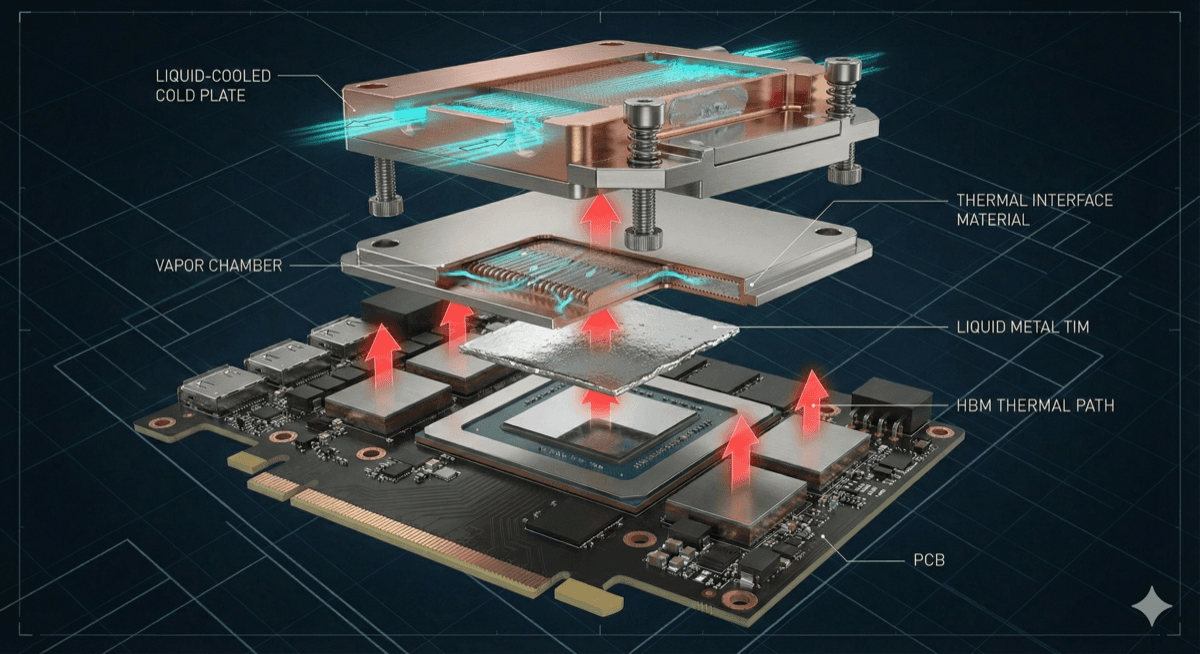
Integrated Heat Spreaders (IHS): The metal lid on GPU packages provides initial heat spreading. Premium designs use nickel-plated copper with optimized geometry. Some packages now include vapor chambers integrated into the IHS for enhanced spreading.
Die-Level Thermal Management: Hotspot-aware die layouts place temperature-critical circuits away from the highest heat flux regions. Some designs include on-die thermal sensors for real-time monitoring and adaptive power management.
3D Stacking Challenges: High-bandwidth memory (HBM) stacked alongside GPUs adds complexity. Heat must escape through the stack without overheating memory layers. Interposer thermal conductivity and heat flow paths become critical.
Advanced TIMs: Liquid metal thermal interfaces (gallium alloys) provide 2-3x better performance than traditional thermal paste. However, they require careful material compatibility analysis and can be challenging to apply consistently.
Backside Cooling: Some experimental designs cool from the backside of the die, providing a more direct thermal path. This requires significant package redesign but could enable substantial improvements.
Chip architects now include thermal engineers from the earliest design stages. The days of designing the chip first and figuring out cooling later are over—thermal considerations now influence transistor placement, power gating strategy, and die floor planning.
System-Level Thermal Architecture
Cooling a 1000W chip requires a system designed from the ground up for thermal performance:
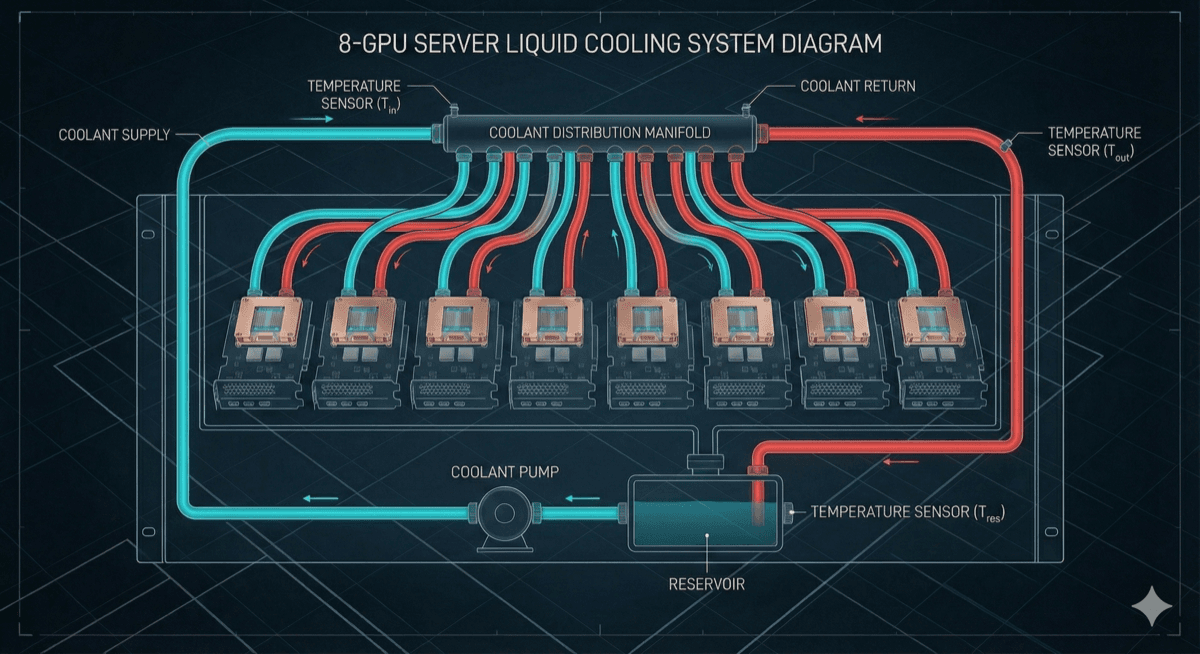
Cold Plate Design: High-performance cold plates for AI accelerators use micro-channel designs with channel widths under 500μm. Jet impingement directly onto the heatspreader is used in some high-end systems. These designs achieve thermal resistances as low as 0.01°C/W but require significant pumping power.
Flow Rate Requirements: Cooling a 1000W GPU with 15°C temperature rise requires approximately 1 L/min flow rate with water. Higher flow rates reduce temperature delta but increase pressure drop and pumping power. System optimization balances these factors.
Pumping Power: The pumps and fans required for cooling can consume 5-10% of IT load power. Reducing this overhead is essential for efficiency. Variable-speed pumps that adjust to actual load conditions are becoming standard.
Manifold Design: In multi-GPU systems (8+ GPUs per node), manifold design ensures equal flow distribution. Poor distribution leads to hot spots even if total flow is adequate. CFD simulation and empirical validation are essential.
Secondary Cooling Loop: The heat removed by cold plates must go somewhere. CDUs, dry coolers, or cooling towers provide the ultimate heat rejection. System design must ensure secondary capacity matches IT load with appropriate margin.
Control System: Sophisticated control systems balance flow rates, pump speeds, and valve positions to maintain target temperatures while minimizing energy consumption. Machine learning-based optimization is increasingly common.
Reliability and Lifecycle Considerations
Operating chips at extreme power densities introduces reliability challenges:
Thermal Cycling: Power cycling from idle to full load causes thermal expansion and contraction. Repeated cycling fatigues solder joints and can lead to cracking. Careful analysis of expected duty cycles informs package design and expected lifetime.
Electromigration: High current densities in power delivery networks cause metal atom migration, eventually leading to open or short circuits. Higher temperatures accelerate electromigration, making thermal management even more critical.
Hot Carrier Injection: Elevated temperatures accelerate hot carrier injection, a transistor degradation mechanism. Junction temperature must stay within rated limits to achieve design lifetime.
Creep and Stress Relaxation: Thermal interface materials under constant pressure and temperature can flow or relax over time, increasing thermal resistance. Material selection and mechanical design must account for long-term behavior.
Condensation: With high-power systems, temperature differences between operating and shutdown states can cause condensation when equipment is powered off. This is particularly concerning in humid environments.
Typical design targets for AI accelerators:
- Junction temperature: 85-95°C maximum
- Thermal cycling: 10,000+ cycles over lifetime
- Operating lifetime: 5-7 years continuous operation
- Mean time between failures: 1M+ hours
Achieving these targets with 1000W power dissipation requires meticulous attention to every aspect of thermal design.
The Road to Higher Power
The trend toward higher power per chip shows no signs of slowing. Industry roadmaps suggest:
Near Term (2024-2025): 1000-1200W GPUs will become common. NVIDIA's Blackwell and AMD's next-generation MI series will push these boundaries. Liquid cooling will be essential, not optional.
Medium Term (2026-2028): Multi-chiplet designs with 1500-2000W total package power are likely. Advanced packaging (chiplets on interposers or in 3D stacks) will require innovative cooling approaches. We may see integrated microfluidic cooling in package substrates.
Long Term (2029+): As AI demands continue scaling, we may see 3000W+ systems. Novel cooling approaches—immersion, two-phase, even thermoelectric—may become necessary. The boundary between chip and cooling system will continue to blur.
For thermal engineers, this trajectory means continuous learning and innovation. The solutions that work for 700W GPUs will be inadequate for 1500W successors. Staying ahead of the power curve requires investment in advanced simulation, prototype testing, and close collaboration with chip designers.
The companies that master kilowatt-scale chip cooling will be positioned to lead in the AI era. The thermal challenge is formidable, but the opportunity is immense.