How to Select the Right Thermal Interface Material (TIM)
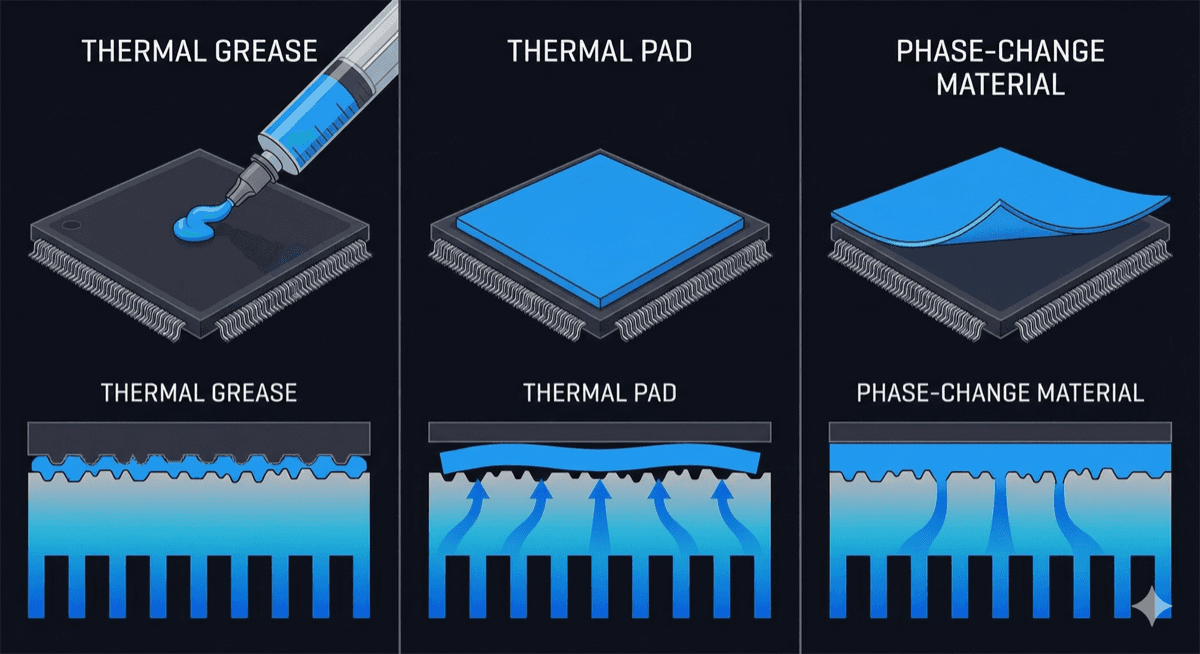
Thermal Interface Materials (TIMs) fill microscopic gaps between heat sources and heat sinks, dramatically reducing thermal resistance at the interface. Selecting the right TIM for your power electronics application requires understanding material properties, application methods, and long-term reliability considerations. This guide covers everything from basic selection criteria to advanced considerations for demanding applications.
Why TIMs Are Critical
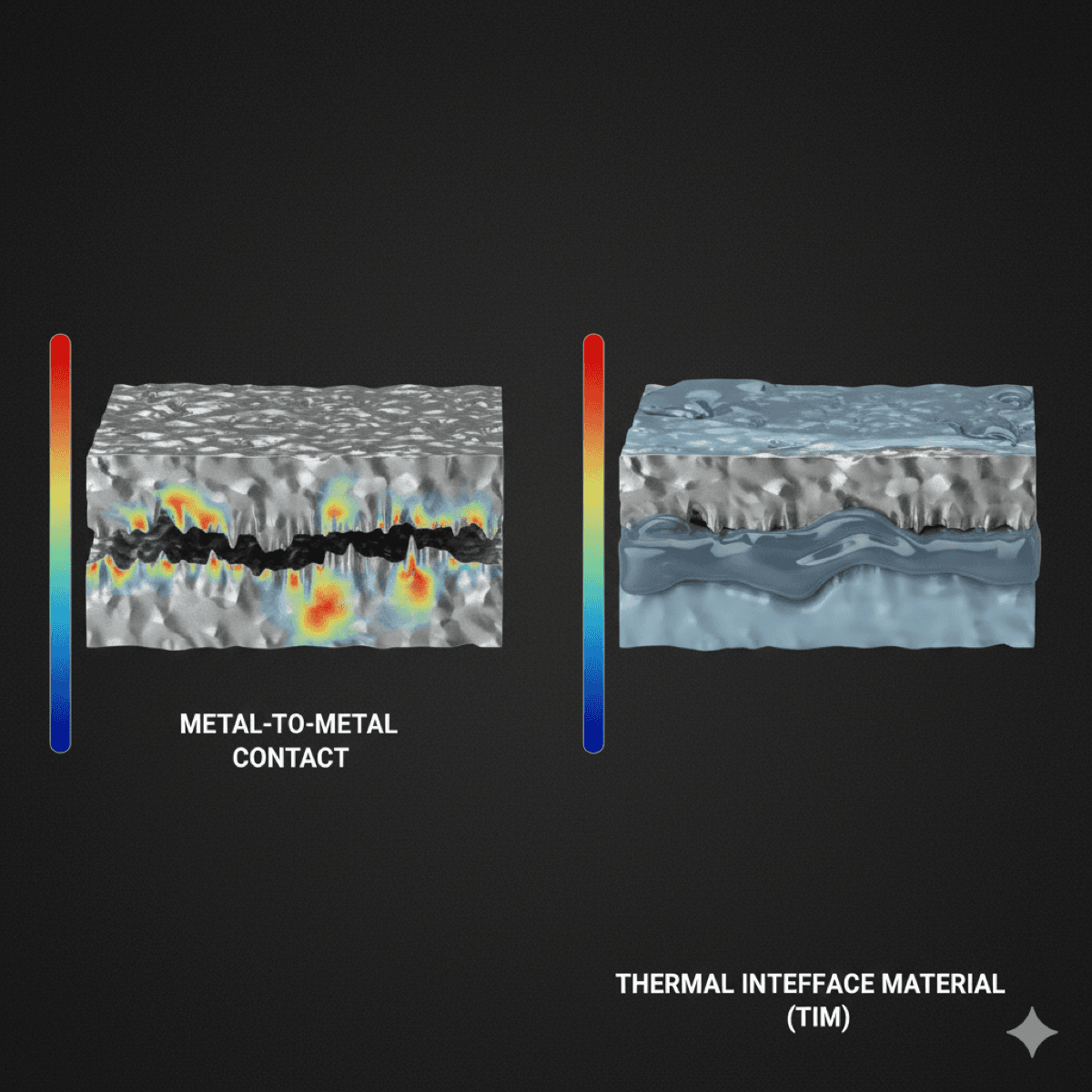
Even machined surfaces that appear flat have microscopic roughness. When two surfaces are pressed together, actual contact occurs at only a small fraction of the apparent area—typically 1-5%. The remaining space is filled with air, which has a thermal conductivity of just 0.026 W/mK.
The Impact of Air Gaps:
Consider a 1cm² interface with 50μm average air gap:
- Air thermal resistance: 0.05mm / (0.026 W/mK × 1cm²) = 19.2°C/W
With a 3 W/mK thermal pad filling the gap:
- Pad thermal resistance: 0.05mm / (3 W/mK × 1cm²) = 0.17°C/W
The TIM reduces interface resistance by over 100×.
Real-World Example:
A 100W IGBT module with junction-to-case thermal resistance of 0.2°C/W:
- Without TIM (air gap): Tj-Tc = 100W × (0.2 + 19.2) = 1940°C (impossible)
- With thermal grease: Tj-Tc = 100W × (0.2 + 0.1) = 30°C (manageable)
The interface can easily dominate total thermal resistance if not properly addressed.
Components of Interface Resistance:
Total interface resistance includes:
- Bulk TIM resistance: t/(k×A)
- Contact resistance at each surface
- Spreading resistance if heat source is smaller than interface
Bulk conductivity matters, but contact resistance often dominates for thin bond lines. A lower-conductivity material that wets surfaces well may outperform a higher-conductivity material with poor contact.
TIM Categories and Properties
TIMs come in various forms, each with distinct advantages and trade-offs.
Thermal Greases:
- Thermal conductivity: 0.5-8 W/mK (typical 2-5 W/mK)
- Bond line: 25-75μm (thinnest possible)
- Advantages: Lowest thermal resistance, excellent surface wetting
- Disadvantages: Messy, can pump out, requires controlled application
- Best for: High-performance applications with stable assembly
Thermal Pads (Gap Pads):
- Thermal conductivity: 1-15 W/mK
- Bond line: 0.5-10mm (conformable)
- Advantages: Easy handling, fills large gaps, electrically isolating options
- Disadvantages: Higher thermal resistance than grease
- Best for: Production assembly, varying gap sizes
Phase Change Materials (PCM):
- Thermal conductivity: 0.7-4 W/mK
- Bond line: 25-125μm at operating temperature
- Advantages: Solid at room temp, flows when hot, consistent bond line
- Disadvantages: Requires initial thermal cycle to wet
- Best for: Repeated assembly/disassembly, consistent manufacturing
Thermal Adhesives:
- Thermal conductivity: 1-4 W/mK
- Bond line: 50-250μm
- Advantages: Bonds components, no mechanical fastening needed
- Disadvantages: Permanent, higher resistance than grease
- Best for: Attaching small components without fasteners
Graphite Sheets:
- In-plane conductivity: 400-1500 W/mK
- Through-plane conductivity: 5-15 W/mK
- Advantages: Excellent spreading, very thin
- Disadvantages: Requires flat surfaces, can be electrically conductive
- Best for: Heat spreading applications
Liquid Metal:
- Thermal conductivity: 20-80 W/mK
- Advantages: Highest performance
- Disadvantages: Electrically conductive, can corrode aluminum
- Best for: CPU/GPU cooling, not typical power electronics
Key Selection Criteria
Choosing the right TIM requires balancing multiple factors:
1. Thermal Conductivity (k)
Higher is generally better, but context matters:
- Below 3 W/mK: Budget applications, large gaps
- 3-6 W/mK: General purpose, good balance of cost/performance
- 6-10 W/mK: High performance applications
- 10+ W/mK: Premium applications, diminishing returns
2. Bond Line Thickness (BLT)
Thinner is better for thermal resistance (R = t/kA), but must accommodate:
- Surface flatness (typ. 50-150μm for machined surfaces)
- Thermal expansion mismatch
- Assembly tolerance stack-up
3. Contact Resistance
Often more important than bulk conductivity. Affected by:
- Surface wetting ability
- Applied pressure
- Surface roughness
4. Operating Temperature Range
Must exceed your application requirements:
- Consumer: -20 to +80°C
- Industrial: -40 to +125°C
- Automotive: -40 to +150°C
- Extreme: -55 to +200°C
5. Electrical Properties
Consider whether isolation is needed:
- Thermal grease: Usually not isolating (can add particles)
- Gap pads: Available in isolating versions (4-10 kV/mm)
- For power modules: Often need 2.5+ kV isolation
6. Long-Term Stability
For 10+ year products, consider:
- Pump-out resistance (greases under thermal cycling)
- Dry-out (loss of volatile components)
- Compression set (permanent deformation of pads)
- Outgassing (contamination of nearby components)
Application Best Practices
Proper application technique is as important as TIM selection.
Thermal Grease Application:
Screen Printing (Production):
- Most consistent method for volume production
- Typical thickness: 50-100μm
- Stencil thickness = desired BLT + ~50%
Dispensing:
- Dot pattern or X pattern for good spread
- Amount: ~1mg per mm² of area
- Let mounting pressure spread material
Manual Application:
- Apply thin layer with spatula or card
- Avoid air bubbles
- Wipe excess from edges
Thermal Pad Application:
Preparation:
- Remove protective films from both sides
- Handle by edges only
- Pre-cut to size if needed
Placement:
- Center on heat source
- Avoid stretching pad
- Don't trap air bubbles
Compression:
- Apply specified mounting pressure
- Typical: 10-50 psi for solid pads
- Use spring washers for consistent force
Phase Change Material:
Pre-attach to heatsink (if possible):
- Apply at room temperature
- Initial thermal cycle activates material
- Re-flow fills gaps completely
Assembly:
- Align carefully—repositioning is difficult
- Apply mounting pressure evenly
- First power-up completes wetting
Critical Considerations:
Surface Preparation:
- Clean surfaces with IPA (isopropyl alcohol)
- Remove any residue from previous TIM
- Ensure surfaces are dry before applying
Mounting Pressure:
- Most TIMs require pressure for optimal performance
- Too little: High contact resistance
- Too much: Material extrusion, potential damage
- Use calibrated torque or force-limiting fasteners
Coverage:
- TIM should cover entire heat source
- Slight overhang is acceptable
- Large overhang wastes material
Reliability and Lifecycle Considerations
Long-term performance is critical for power electronics with 10-20 year expected lifespans.
Thermal Cycling Effects:
Pump-Out:
- Greases can migrate out of interface under thermal cycling
- Caused by differential expansion between surfaces
- Mitigation: Use gel-type greases, PCM, or pads
Compression Set:
- Soft pads permanently deform, losing compliance
- Can create gaps as surfaces move
- Mitigation: Use firm pads, adequate preload
Dry-Out:
- Volatile components evaporate over time
- Increases thermal resistance
- Mitigation: Select non-volatile formulations
Environmental Factors:
Temperature:
- Verify TIM rating exceeds max operating temp
- Consider peak transient temperatures
- Some materials soften excessively at high temp
Humidity:
- Most TIMs are moisture-resistant
- Verify for outdoor/humid environments
- Consider sealed interfaces for demanding apps
Chemicals:
- Check compatibility with cleaning agents
- Avoid silicone contamination if painting nearby
- Some TIMs incompatible with certain plastics
Testing for Reliability:
Thermal Cycling Test:
- 500-1000 cycles between extremes
- -40 to +125°C typical for automotive
- Measure thermal resistance before/after
High Temperature Aging:
- 1000-2000 hours at maximum rated temp
- Monitor for dry-out, degradation
- Accept max 20% resistance increase
Power Cycling:
- More severe than thermal cycling
- Junction temperature swing creates local stress
- 10,000+ cycles typical requirement
When to Use Which:
For high reliability (automotive, industrial):
- PCM or gel greases (resist pump-out)
- Premium pads with low compression set
- Thorough qualification testing
For production ease:
- Pre-cut gap pads
- PCM pre-attached to heatsink
- Phase change eliminates grease application variability
Practical Selection Guide
Based on your application requirements, here's a practical selection approach:
Step 1: Determine Gap Requirements
Measure or estimate:
- Surface flatness of both surfaces
- Assembly tolerance stack-up
- Thermal expansion mismatch
If gap < 100μm: Grease or PCM If gap 0.1-1mm: Thin gap pad or thick PCM If gap > 1mm: Soft gap pad
Step 2: Calculate Required Performance
Target interface resistance: Rth_int = (Tj_max - Ta - Rth_jc × P - Rth_sa × P) / P
If Rth_int < 0.1°C/W: High-performance grease needed If Rth_int 0.1-0.5°C/W: Standard grease or quality pad If Rth_int > 0.5°C/W: Basic pad adequate
Step 3: Consider Application Requirements
High Volume Production: → Gap pads or pre-applied PCM for consistency
Frequent Rework Expected: → PCM (reflows on re-assembly)
Vibration/Shock Environment: → Pads (won't pump out)
Extreme Temperature: → Specialty high-temp greases or pads
Step 4: Validate Selection
- Obtain samples from 2-3 vendors
- Build test assemblies
- Measure thermal performance
- Run accelerated reliability tests
- Evaluate production compatibility
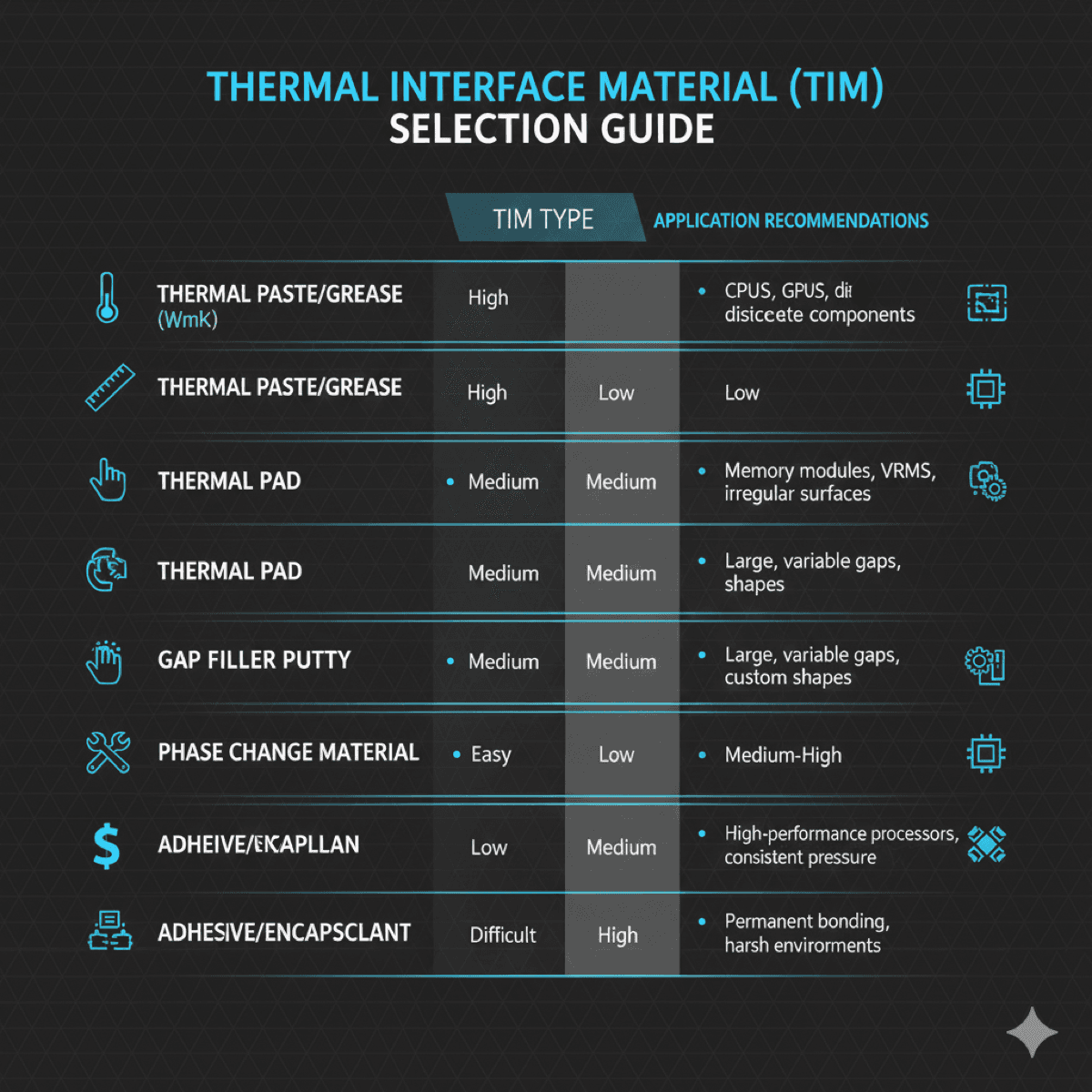
Quick Reference:
| Application | Recommended TIM | |------------|-----------------| | High-power IGBT | Premium grease + precise mounting | | TO-247 devices | 0.2-0.5mm gap pad | | PCB-mount FETs | Thermal adhesive or pad | | LED arrays | PCM or thin gap pad | | Battery cells | Soft gap pad (conforms to cylindrical) | | Variable gap | Conformable silicone pad |