Natural Convection vs Forced Air Cooling: Design Trade-offs
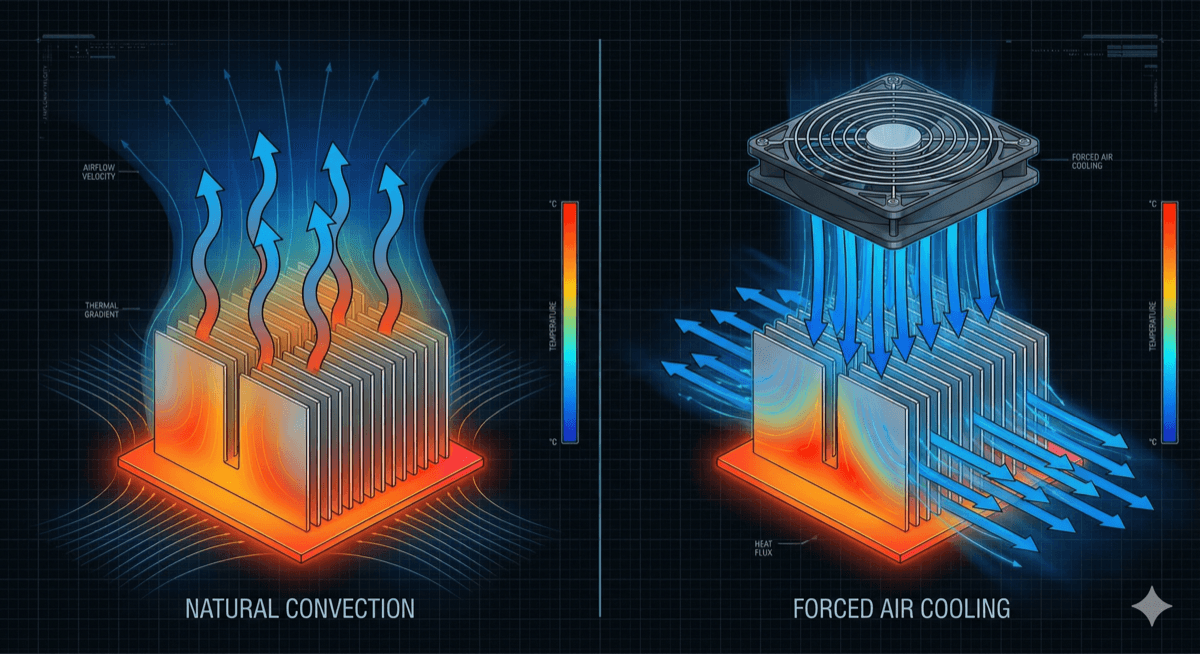
Choosing between natural convection and forced air cooling fundamentally shapes your thermal management approach. This comparison examines the performance characteristics, design considerations, and trade-offs of each method to help you select the optimal cooling strategy for your power electronics application.
Fundamentals of Convective Cooling
Both natural and forced convection transfer heat from surfaces to moving air, but the driving mechanisms differ significantly.
Natural Convection:
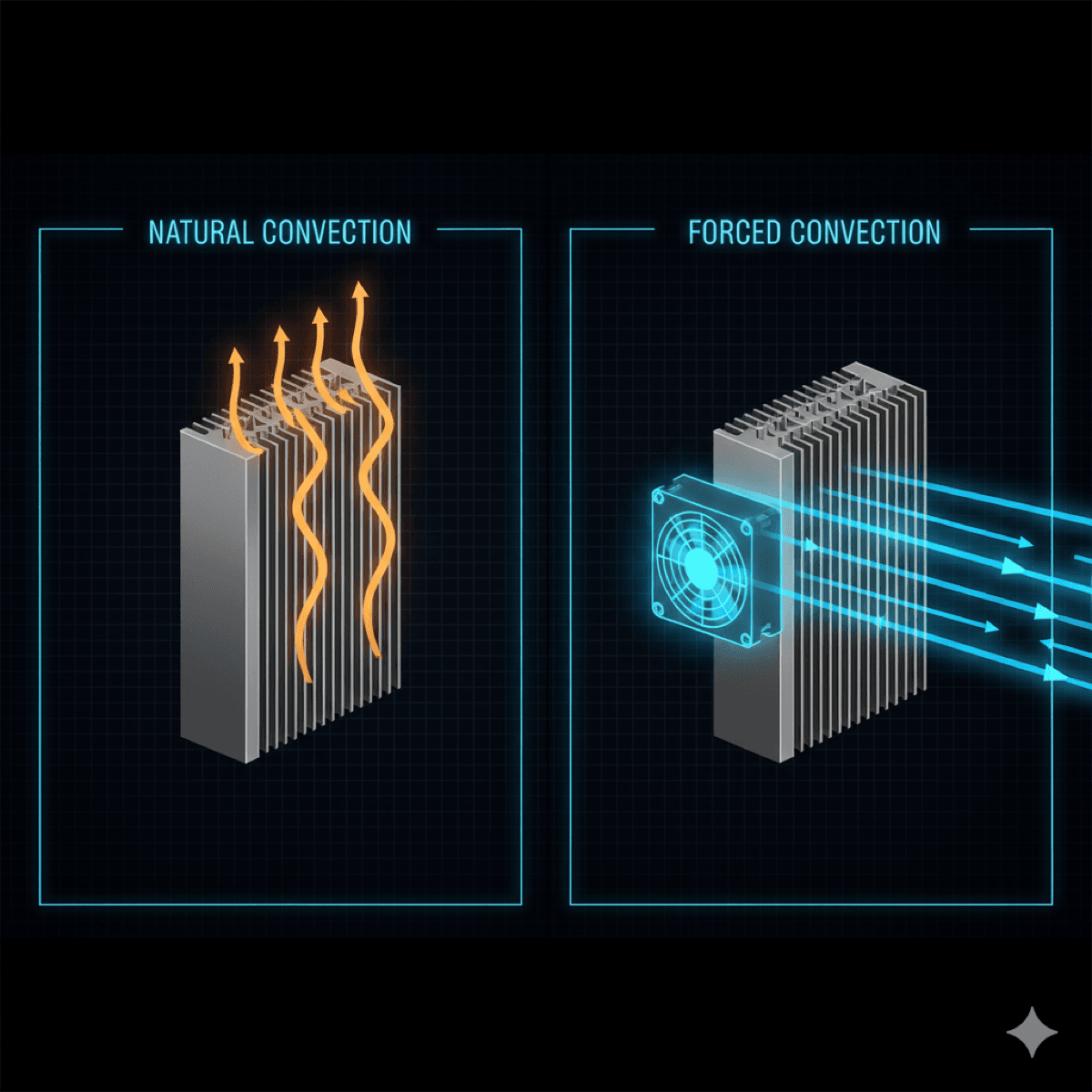
Driving force: Buoyancy from heated air (density difference) Heat transfer coefficient: 5-25 W/m²K Air velocity: 0.1-0.5 m/s (self-induced)
The process:
- Heatsink heats adjacent air
- Warm air becomes less dense
- Buoyancy causes air to rise
- Cooler air flows in to replace it
- Creates self-sustaining circulation
Forced Convection:
Driving force: Fan or blower creating pressure differential Heat transfer coefficient: 25-250 W/m²K Air velocity: 1-10 m/s (typical electronics cooling)
The process:
- Fan creates pressure differential
- Air flows over heated surfaces
- Forced flow much faster than natural
- Higher velocity = thinner boundary layer
- Better heat transfer independent of orientation
Performance Comparison:
Forced air achieves 5-10× higher heat transfer coefficient. This translates to:
- Smaller heatsinks for same power
- Lower thermal resistance
- Higher power density capability
Key Equations:
Natural convection (vertical plate): h ≈ 1.42 × (ΔT/L)^0.25 [W/m²K]
Forced convection: h ≈ 3.86 × v^0.5 / x^0.5 [W/m²K]
Where v = velocity, x = distance from leading edge
Natural Convection Design
Natural convection cooling offers simplicity and reliability but requires careful design to maximize performance.
When Natural Convection Works:
- Power dissipation < 50-100W
- Adequate enclosure volume
- No tight space constraints
- Reliability is paramount
- Silent operation required
- Ambient temperature < 35°C
Design Guidelines:
Heatsink Orientation:
- Vertical fins: 30-40% better than horizontal
- Fins parallel to gravity (vertical)
- Avoid obstructing flow at top/bottom
Fin Geometry:
- Fin spacing: 6-12mm (wider than forced air)
- Closer spacing creates too much flow resistance
- Optimum depends on height and ΔT
Fin Height:
- Diminishing returns above 50mm
- Natural convection air speed limits heat transfer
- Additional height adds negligible benefit
Fin Thickness:
- Minimum for structural support (1-2mm)
- Thick fins waste material with limited benefit
Surface Finish:
- Black anodize: 20-30% improvement from radiation
- Radiation significant at natural convection velocities
- Dark colors always better
Enclosure Considerations:
Ventilation:
- Inlet vents at bottom
- Outlet vents at top
- Vent area: 2× heatsink base area minimum
Clearance:
- Minimum 25mm above heatsink
- Minimum 10mm below and sides
- Avoid obstructions in airflow path
Estimating Performance:
Rough estimate for vertical rectangular heatsink: Rth ≈ 1 / (0.1 × A^0.8)
Where A = total surface area in cm² Result in °C/W (±30% accuracy)
Forced Air Cooling Design
Forced air cooling enables higher power densities but adds complexity and potential failure modes.
When Forced Air is Needed:
- Power dissipation > 100W
- Space constraints limit heatsink size
- High ambient temperatures
- Sealed enclosure (with filtered inlet)
- High power density required
Fan Selection:
Parameters to consider:
- Airflow (CFM or m³/h)
- Static pressure (Pa or inches H₂O)
- Noise (dBA)
- Voltage and power consumption
- Reliability (MTBF)
Types:
- Axial fans: High flow, low pressure
- Centrifugal blowers: Lower flow, high pressure
- Mixed flow: Compromise between both
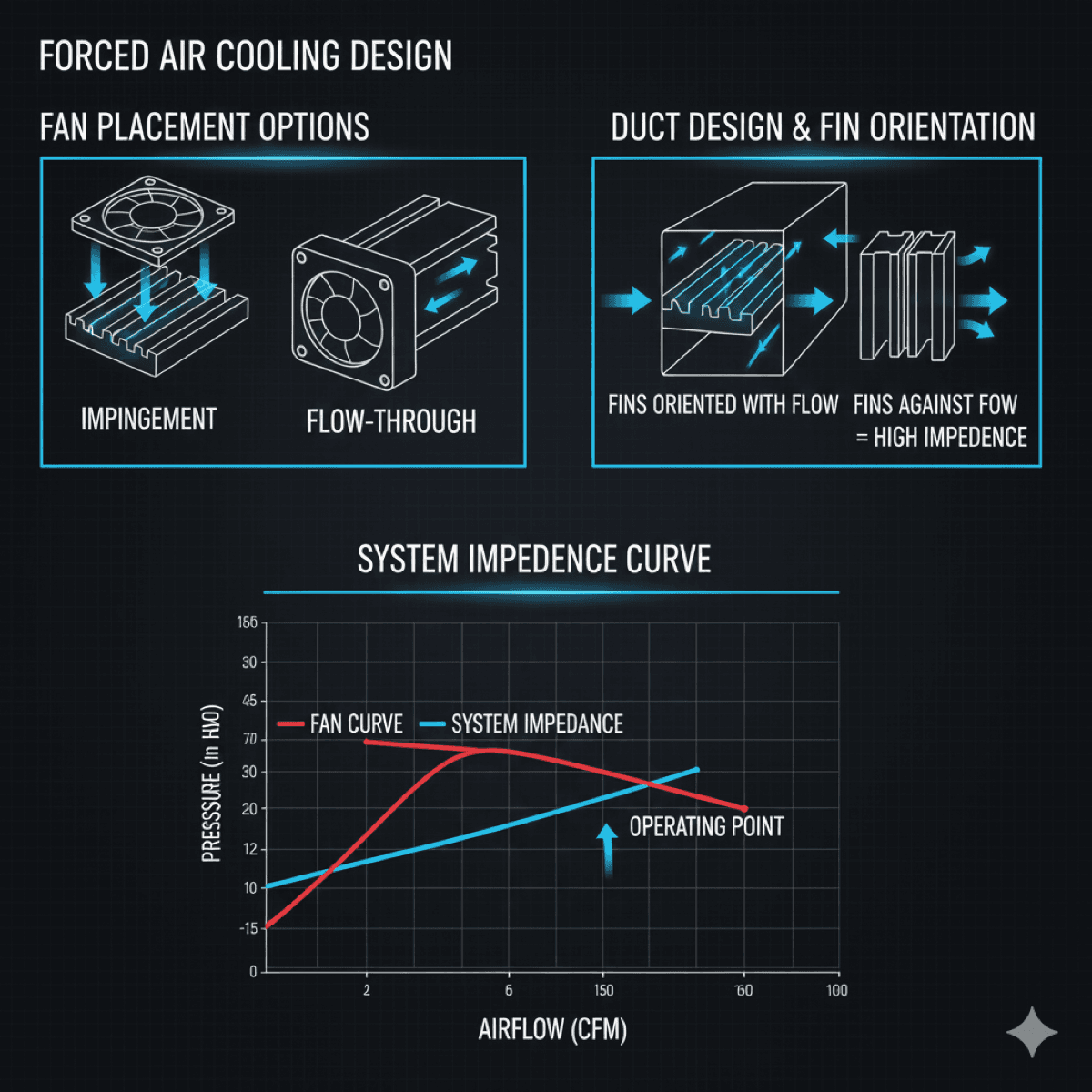
System Operating Point:
Fans must overcome system pressure drop. Operating point is intersection of:
- Fan P-Q curve
- System resistance curve
System resistance: ΔP ∝ Q² (Pressure drop increases with square of flow)
Heatsink Design for Forced Air:
Fin spacing:
- Optimal: 1.5-3mm
- Closer than natural convection (higher velocity)
- Too close: Pressure drop excessive
Fin height:
- Can be taller than natural convection
- Airflow not self-limiting
- Balance against pressure drop
Configuration:
- Cross-flow (fins perpendicular to flow)
- Parallel flow (fins aligned with flow)
- Cross-flow generally more compact
Airflow Path:
Direct impingement:
- Fan blows directly onto heatsink
- Best for concentrated heat sources
Flow-through:
- Air flows through heatsink fins
- Better for distributed heat sources
Duct:
- Channel air to where needed
- Reduces bypass losses
- Adds system complexity
Key Design Mistake:
Bypass flow: Air taking the easy path around heatsink instead of through it.
Mitigation:
- Seal gaps around heatsink
- Use shrouds or ducts
- Fan mounted directly to heatsink
Performance Comparison
Quantitative comparison helps with technology selection and sizing.
Thermal Resistance Comparison:
100cm² heatsink footprint:
Natural convection (optimized):
- Rth ≈ 1.5-3°C/W
Forced air (2 m/s):
- Rth ≈ 0.3-0.6°C/W
Forced air (5 m/s):
- Rth ≈ 0.15-0.3°C/W
Forced air provides 5-10× better performance.
Power Density Capability:
Natural convection:
- Typical: 0.5-2 W/cm² (heatsink base area)
- Maximum practical: 3-5 W/cm²
Forced air:
- Typical: 3-10 W/cm²
- Aggressive: 15-25 W/cm²
- With high-velocity air: 30+ W/cm²
Size/Weight Comparison:
For 100W dissipation at 50°C rise:
Natural convection:
- Heatsink: ~500cm² base area
- Weight: ~2kg (aluminum)
Forced air (moderate):
- Heatsink: ~100cm² base area
- Fan weight: ~0.1kg
- Total: ~0.5kg
Forced air is 4× smaller and lighter.
Noise Comparison:
Natural convection: 0 dBA (silent)
Forced air:
- Low-speed fan: 20-30 dBA
- Medium fan: 30-40 dBA
- High-speed fan: 40-50+ dBA
Reliability Comparison:
Natural convection:
- No moving parts
- MTBF: Essentially infinite (thermal)
- Main failure: Component aging
Forced air:
- Fan MTBF: 30,000-100,000 hours (ball bearing)
- Sleeve bearing: 20,000-50,000 hours
- Main failure: Fan, filter clogging
Trade-off Analysis
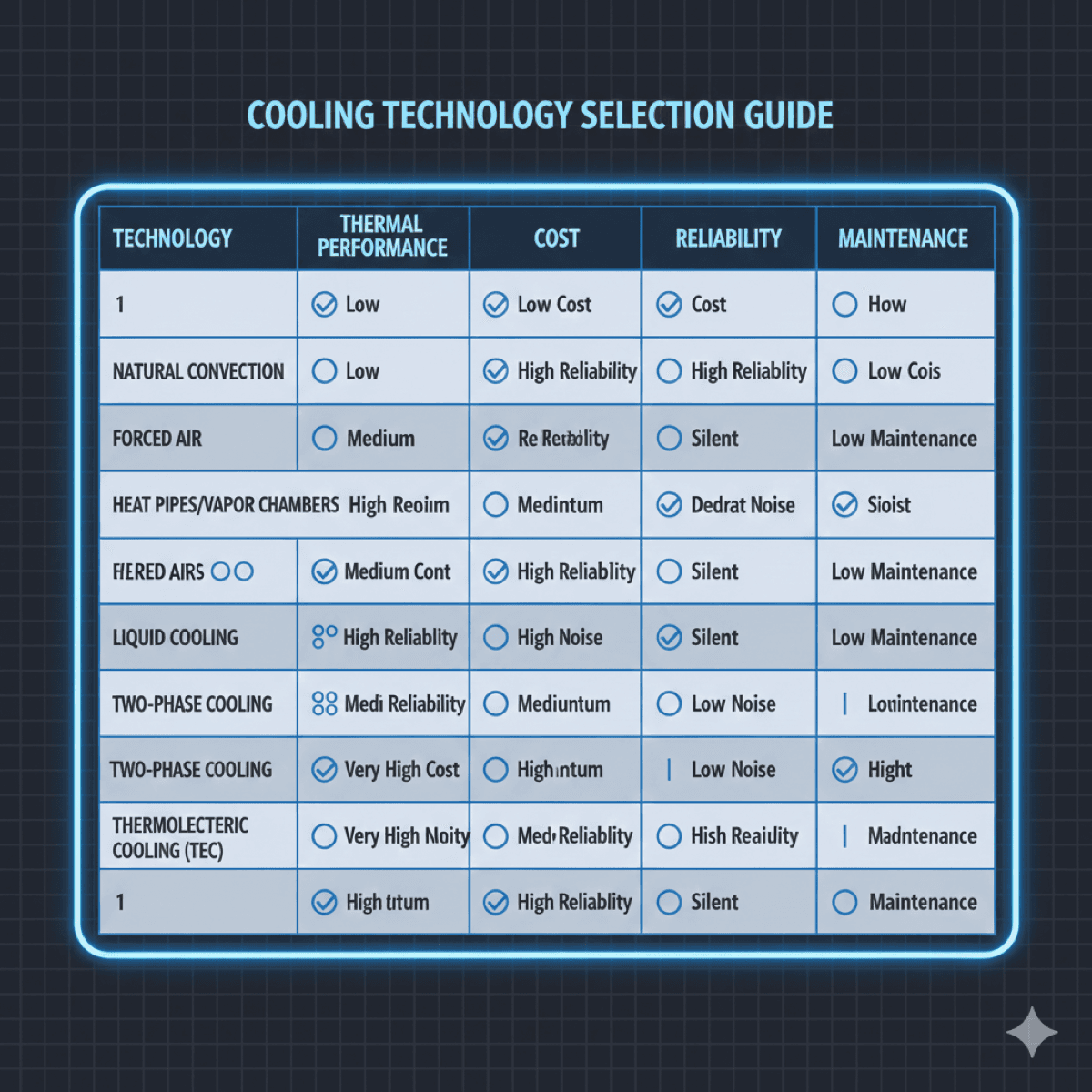
Selecting between cooling approaches requires weighing multiple factors.
Cost Analysis:
Initial cost:
- Natural: Heatsink only
- Forced: Heatsink + fan + mounting
Operating cost:
- Natural: Zero (no power consumption)
- Forced: Fan power (1-20W typical)
Maintenance cost:
- Natural: None
- Forced: Fan replacement, filter cleaning
Over 10-year life for 100W application: Natural convection: $50-100 total Forced air: $30 (smaller HS) + $20 (fan) + $50 (electricity) + $40 (maintenance) = $140
Natural may be cheaper despite larger heatsink.
Reliability Analysis:
System availability requirement: 99.9%
Natural convection:
- Achieves target with standard heatsink
- No wear-out mechanisms
Forced air:
- Requires fan monitoring
- Backup fan or oversize heatsink for fan failure
- Regular maintenance schedule
Application-Specific Considerations:
Industrial/outdoor:
- Dust, debris → filter maintenance for forced air
- Moisture → corrosion concerns for fans
- Often favors natural convection
Consumer electronics:
- Noise critical → limits fan speed
- Size critical → often requires forced air
- Cost sensitive → balance carefully
Telecommunications:
- Reliability paramount
- Often uses natural + oversized heatsinks
- Or redundant fans
Medical:
- Noise restrictions
- Cleanroom compatible fans
- Often sealed with internal fans
Hybrid and Alternative Approaches
Sometimes the best solution combines approaches or uses alternatives.
Hybrid: Fan-Assisted Natural Convection:
Low-speed fan assists natural convection:
- Runs only when needed
- Extends natural convection range
- Provides backup cooling capacity
Implementation:
- Temperature-controlled fan speed
- Start fan above threshold (e.g., 60°C heatsink)
- Gradually increase speed as needed
Benefits:
- Mostly silent operation
- Smaller heatsink than pure natural
- More reliable than full-time fan
Chimney Effect:
Enclosed vertical duct around heatsink:
- Accelerates natural convection
- 50-100% improvement possible
- No moving parts
Design:
- Height enhances buoyancy effect
- Cross-section sized to minimize resistance
- Open top and bottom
Thermal Storage:
For intermittent loads:
- Phase change material absorbs peak heat
- Natural convection handles average load
- Avoids fan for occasional peaks
Materials:
- Paraffin wax (common)
- Salt hydrates
- Metal foams with PCM
Thermoelectric (Peltier):
Active cooling below ambient:
- Used where natural/forced can't meet requirements
- High power consumption (low COP)
- Adds complexity
Applications:
- Precision temperature control
- Sub-ambient cooling
- Small form factor
Making the Decision:
Start with natural convection: → If heatsink fits and meets thermal requirements, done
If not adequate: → Try low-speed fan assist → Can requirements be met with occasional fan?
If continuous forced air needed: → Design for fan failure (alarm, redundancy) → Size for maintainability → Consider liquid cooling if very high power